Tungsten Copper Ring
1. What's Tungsten Copper Ring?
Tungsten copper ring is ring-shaped component made from tungsten (W) and copper (Cu), combining tungsten's high melting point, high hardness, and low coefficient of thermal expansion with copper's electrical and thermal conductivity. The tungsten-to-copper ratio affects electrical conductivity, hardness, density, and thermal expansion, making different compositions suitable for different operating conditions. Tungsten copper rings are generally produced by powder metallurgy, using processes such as tungsten skeleton sintering and copper infiltration, followed by precision machining to achieve the required inner diameter, outer diameter, height, and dimensional tolerances.
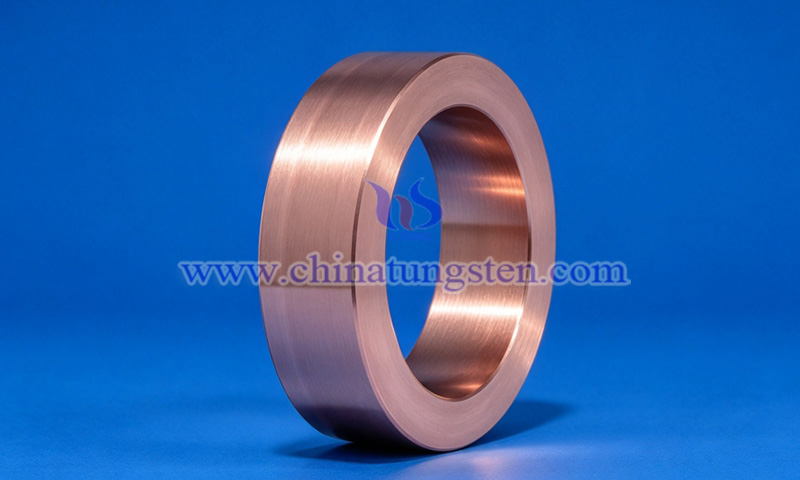
2. Characteristics of CTIA's Tungsten Copper Ring
(1) Efficient Electrical and Thermal Conduction: Delivers superior electrical and thermal conductivity at higher copper contents, satisfying requirements for current transmission and heat dissipation in demanding components.
(2) Superior High-Temperature and Arc Erosion Resistance: Withstands intense arc heat and localized erosion through tungsten's high melting point, serving as an ideal choice for electrical switch applications.
(3) Low Thermal Expansion and Dimensional Stability: Reduces thermal expansion coefficient at higher tungsten contents, helping control temperature-induced dimensional changes and improving thermal expansion matching with adjacent materials.
(4) Elevated Hardness and Wear Resistance: Provides high hardness at elevated tungsten contents, adapting well to parts subject to contact wear or cyclic operating loads.
(5) Precision Ring Geometry and Customizable Sizing: Accommodates tailored inner diameter, outer diameter, height, and wall thickness to meet structural requirements for sleeve fitting, positioning, and annular contact assemblies.
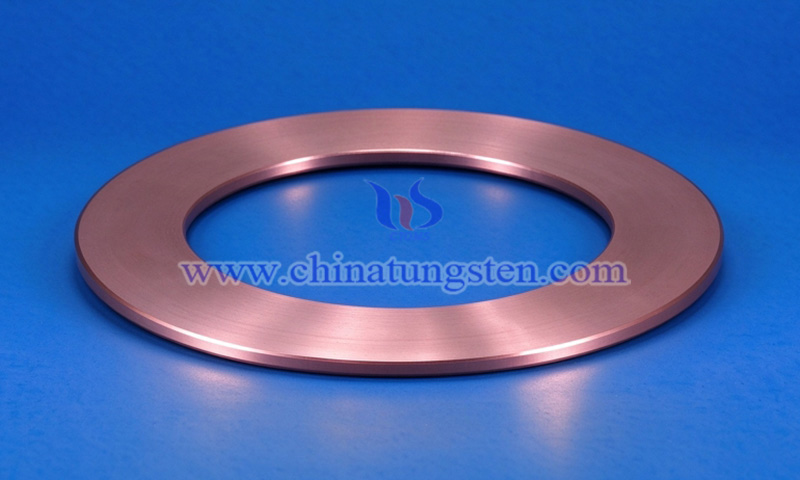
3. Applications of CTIA's Tungsten Copper Ring
(1) High-Voltage Switch Ring Contacts: Annular contact surfaces provide a ring-shaped conductive contact area for certain circuit breakers and high-voltage switchgear, accommodating current loads and arc exposure during switching.
(2) Ring-Shaped Resistance Welding Electrodes: The ring structure suits workpieces with annular welding areas, concentrating current within designated contact zones for resistance welding of specific ring-shaped joints.
(3) Ring-Shaped Electrical Discharge Machining Electrodes: Used in electrodes requiring a central hole or annular profile, facilitating the machining of grooves, hole openings, and other specific contours.
(4) Ring-Shaped Electronic Packaging Components: Used in certain annular packaging structures for power electronic devices. The ring shape accommodates central holes, axial mounting, or peripheral connections, depending on the device design.
4. Specifications of CTIA's Tungsten Copper Ring
(1) Material Grades: CuW50, CuW55, CuW60, CuW65, CuW70, CuW75, CuW80, CuW85, and CuW90
(2) Dimensions: Outer diameter, inner diameter, and height; customizable
(3) Dimensional Tolerances: Inner and outer diameters, height, and geometrical tolerances can be customized
CTIA GROUP has nearly 30 years of experience in tungsten copper alloy manufacturing, with extensive expertise in tungsten powder compaction, tungsten skeleton sintering, copper infiltration, and precision machining. CTIA provides customized design and machining solutions for tungsten copper rings based on material composition, inner and outer diameters, height, and dimensional accuracy, meeting manufacturing requirements for electrical switchgear, welding electrodes, electrical discharge machining, and electronic heat dissipation components.
For any inquiry, please contact tungsten copper manufacturer: CTIA GROUP
Email: sales@chinatungsten.com
Tel: 0086 592 5129696 / 0086 592 5129595
Website: tungsten-copper.com
WeChat: