Tungsten Copper Sheet
1. What's Tungsten Copper Sheet?
Tungsten copper sheet, also known as copper tungsten sheet, is a composite material primarily composed of tungsten (W) and copper (Cu), manufactured using powder metallurgy. Since tungsten and copper are mutually insoluble, the material is not a conventional solid-solution alloy but a pseudo-alloy consisting of separate tungsten and copper phases. CTIA uses processes such as tungsten powder compaction, tungsten skeleton sintering, and copper infiltration to fill the pores of a porous tungsten skeleton with copper, forming a dense composite structure. The tungsten phase provides high melting point, high hardness, high-temperature resistance, and resistance to arc erosion, while the copper phase offers good electrical and thermal conductivity. By combining the complementary properties of these two metals, CTIA's tungsten copper sheet offers good electrical and thermal conductivity, resistance to arc erosion, high strength, and adjustable coefficient of thermal expansion. It is suitable for electrical contacts, electronic packaging, heat dissipation components, and high-temperature industrial parts.
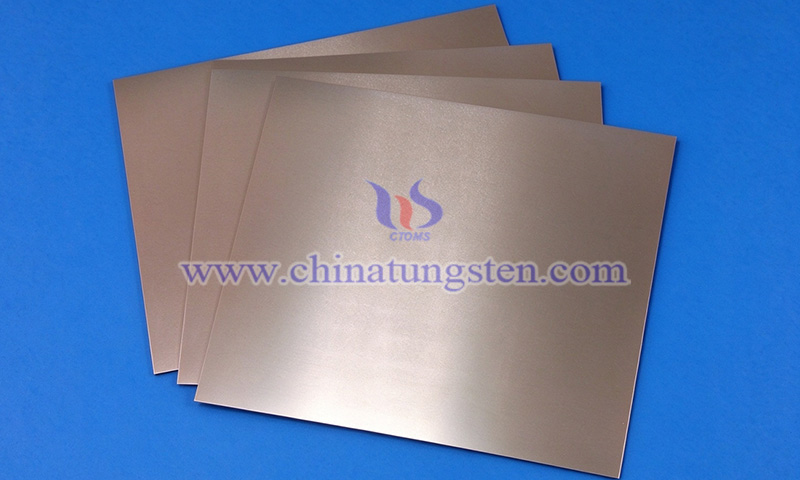
2. Characteristics of CTIA's Tungsten Copper Sheet
(1) Resistance to Arc Erosion: Tungsten's high melting point and high-temperature resistance help tungsten copper sheet withstand intense arc heat, making it suitable for arcing contacts in medium- and high-voltage switches and circuit breakers.
(2) Good Electrical Conductivity: Electrical conductivity varies with copper content, with common tungsten copper grades offering approximately 27%–54% IACS. Composition can be selected according to current load and arc erosion resistance requirements.
(3) Good Thermal Conductivity: Tungsten copper sheet transfers heat efficiently with thermal conductivity of approximately 140–290 W/(m·K), making it suitable for heat sinks, electronic packaging substrates, and thermal management plates.
(4) Adjustable Coefficient of Thermal Expansion: Coefficient of thermal expansion typically ranges from approximately 6.4 to 13.3 × 10⁻⁶/K from room temperature to 800°C, depending on composition. It is suitable for electronic packaging and precision components requiring thermal expansion matching and dimensional stability.
(5) High Hardness and Strength: Common tungsten copper grades have hardness of approximately 100–280 HB, while flexural strength of certain grades can reach 790–1160 MPa. Actual values depend on composition and manufacturing processes.
(6) Customizable Material Composition: CTIA can select appropriate tungsten copper material ratios and processing schemes based on product requirements for electrical conductivity, thermal conductivity, arc erosion resistance, thermal expansion, and mechanical properties.
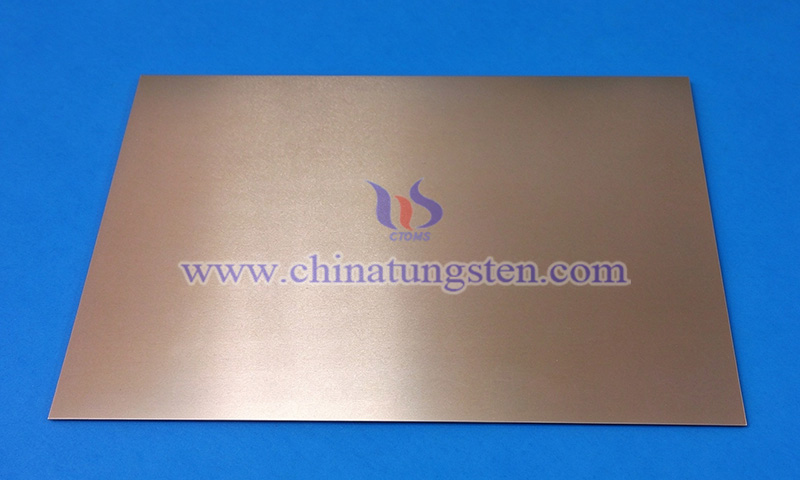
3. Applications of CTIA's Tungsten Copper Sheet
(1) Power and Electrical Equipment: Used for contacts and arcing contact components in medium- and high-voltage switches, circuit breakers, and vacuum switching equipment. Tungsten copper sheet can be cut and precision-machined according to component drawings to meet electrical conductivity and arc erosion resistance requirements.
(2) Electronic Packaging and Heat Dissipation: Used in sheet components such as electronic packaging substrates, heat sink plates, and thermal management plates. Its adjustable thermal expansion and thermal conductivity help meet the heat dissipation and thermal expansion matching requirements of electronic components.
(3) High-Power Electronic Devices: Used in packaging substrates and heat dissipation components for microwave, laser, Radio Frequency (RF), and optical communication equipment, helping dissipate heat generated during device operation.
(4) Electrical Discharge Machining and Welding: Can be machined into Electrical Discharge Machining (EDM) electrodes, resistance welding electrodes, and related conductive components. Specific materials and structures are determined based on processing methods, current conditions, and operating environments.
(5) Aerospace: Used for sheet parts and functional components requiring thermal conductivity, high-temperature resistance, and thermal expansion control. Material selection must be combined with operating temperatures, thermal loads, and structural requirements.
4. Specifications of CTIA's Tungsten Copper Sheet
(1) Material Grades: W50Cu50, W55Cu45, W60Cu40, W65Cu35, W70Cu30, W75Cu25, W80Cu20, W85Cu15, W90Cu10, and W93Cu7.
(2) Dimensions: Length: 10–1500 mm; width: 10–500 mm; thickness: 0.1–50 mm.
(3) Machining Processes: Cutting, milling, grinding, and drilling, etc.
(4) Dimensional Tolerances: Customizable according to customer requirements.
CTIA GROUP has nearly 30 years of experience in tungsten copper alloy manufacturing, with extensive expertise in powder metallurgy, liquid-phase sintering, copper infiltration, and precision machining. CTIA provides material selection, structural design, customized dimensions, and precision machining for tungsten copper sheets to meet specific requirements for electrical and thermal conductivity, arc erosion resistance, thermal expansion, and dimensional accuracy across power and electrical equipment, electronic packaging, aerospace, and other applications.
For any inquiry, please contact tungsten copper manufacturer: CTIA GROUP
Email: sales@chinatungsten.com
Tel: 0086 592 5129696 / 0086 592 5129595
Website: tungsten-copper.com
WeChat: