Tungsten Copper Contact
1. What's Tungsten Copper Contact?
Tungsten copper contact is a metal composite electrical contact made with tungsten (W) as the high-temperature-resistant framework and copper (Cu) as the conductive and heat-dissipating phase. It is manufactured using powder metallurgy and copper infiltration processes. CTIA's tungsten copper contacts combine tungsten's high-temperature resistance and arc erosion resistance with copper's electrical and thermal conductivity, making them suitable for specific contact components in high-voltage circuit breakers, vacuum circuit breakers, load switches, and other switching equipment.
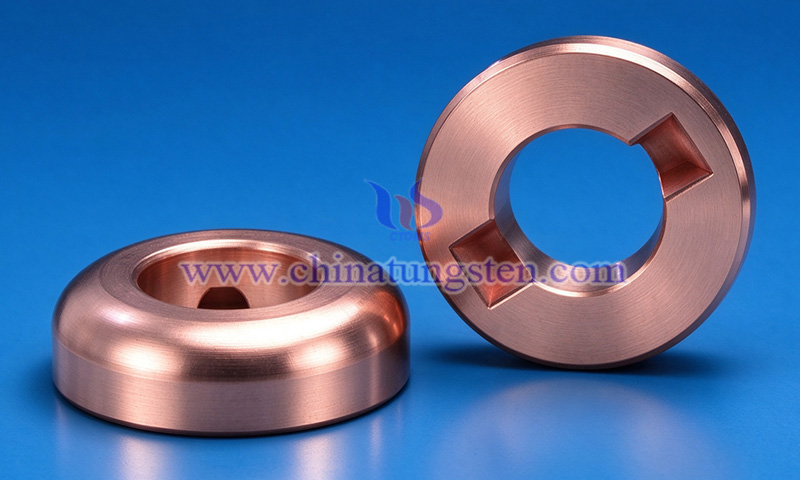
2. Characteristics of CTIA's Tungsten Copper Contact
(1) Arc Erosion Resistance & Reduced Contact Wear: Tungsten has high melting point and good high-temperature stability, helping reduce contact melting and arc erosion caused by electrical arcs during switching operations.
(2) Anti-Welding Resistance & Reduced Risk of Sticking: Lowers risk of localized melting and sticking under high temperatures, heavy currents, and contact pressure, enhancing separation reliability.
(3) Electrical & Thermal Conductivity to Reduce Heat Accumulation: Copper phase aids in conducting current and dissipating heat, lowering contact temperature rise. Tungsten-to-copper ratio affects electrical and thermal performance; material selection must balance current-carrying capacity with arc resistance.
(4) Transpiration Cooling to Mitigate Localized Overheating: Under intense arcing, copper phase may melt and exude to surface, absorbing heat through melting and vaporization to relieve localized overheating.
(5) High Hardness & Mechanical Wear Resistance: Tungsten phase increases hardness and wear resistance, withstanding contact pressure and mechanical stresses from repeated operations. Higher tungsten content generally yields higher hardness and bending strength at expense of conductivity.
(6) Low Coefficient of Thermal Expansion & Dimensional Stability: Tungsten copper material minimizes dimensional variations caused by temperature changes, maintaining stable contact dimensions and fitting tolerances.
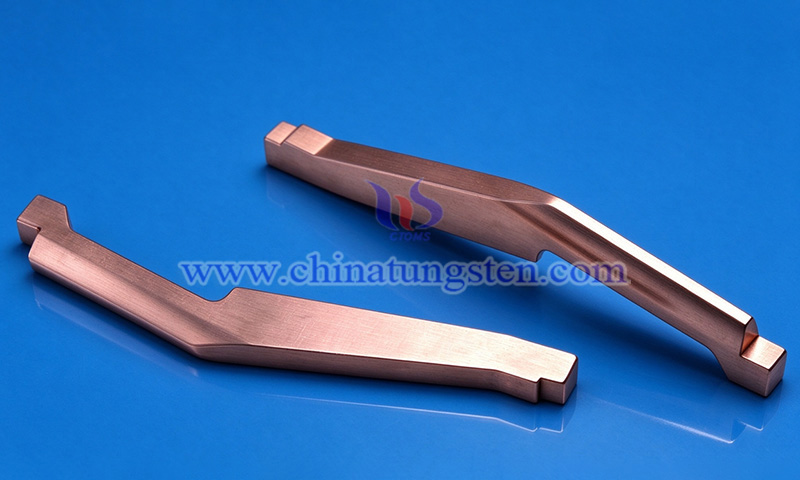
3. Types of CTIA's Tungsten Copper Contact
(1) Circuit Breaker Contacts: Used in current-carrying, making, and interrupting sections of circuit breakers; some designs separate the functions of main contacts and arcing contacts, with arcing contacts bearing most of the arc impact.
(2) Disconnector Contacts: Used in the conductive contact sections of disconnectors, meeting requirements for electrical conduction, contact pressure, and wear resistance during circuit isolation.
(3) Load Switch Contacts: Used in contact and breaking sections of load switches, adapting to arc effects during normal load current switching.
(4) Vacuum Switch Contacts: Used as specialized contact components in vacuum circuit breakers, vacuum contactors, and other equipment, helping reduce contact welding and improve interruption reliability.
(5) On-Load Tap Changer Contacts: Used as switching contacts or arc-resistant components in transformer on-load tap changers, withstanding current variations and arc erosion during switching.
4. Applications of CTIA's Tungsten Copper Contact
(1) High- and Extra-High-Voltage Circuit Breakers: Used as arcing contacts, moving arcing contacts, and fixed arcing contacts, offering strong arc erosion resistance to reduce contact wear.
(2) Vacuum Switching Equipment: Used as specialized contacts in vacuum circuit breakers, vacuum contactors, and reclosers, offering resistance to contact welding and arc erosion.
(3) Power Grid Isolation and Switching Equipment: Used as arc-resistant contacts in disconnectors, load switches, and transformer on-load tap changers, providing wear resistance and extended service life.
(4) Discharge and Overvoltage Protection Equipment: Used as spark gap discharge electrodes and arc-resistant electrical contact components, withstanding transient arc impact while limiting surface erosion.
(5) High-Current Contactors and Special-Purpose Switches: Used in industrial high-current contactors and specialized load switches, offering resistance to contact welding and arc erosion for frequent switching operations.
(6) Specialized Pulsed-Power Equipment: Used as contacts in high-power pulsed systems and research discharge equipment, withstanding transient high-current loads.
5. Specifications of CTIA's Tungsten Copper Contact
(1) Common materials: WCu70, WCu75, WCu80, WCu85, etc.
(2) Product Forms: Arcing contacts, moving contacts, fixed contacts, etc.
(3) Structural Designs: Integral contacts, composite contacts, and embedded contacts, etc.
(4) Dimensions and Tolerances: Customizable.
CTIA GROUP has nearly 30 years of experience in tungsten copper manufacturing and extensive expertise in powder metallurgy and precision machining. CTIA develops contact solutions based on switching equipment type, contact structure, and interruption conditions, covering material selection, structural design, dimensional customization, and precision machining.
For any inquiry, please contact tungsten copper manufacturer: CTIA GROUP
Email: sales@chinatungsten.com
Tel: 0086 592 5129696 / 0086 592 5129595
Website: tungsten-copper.com
WeChat: